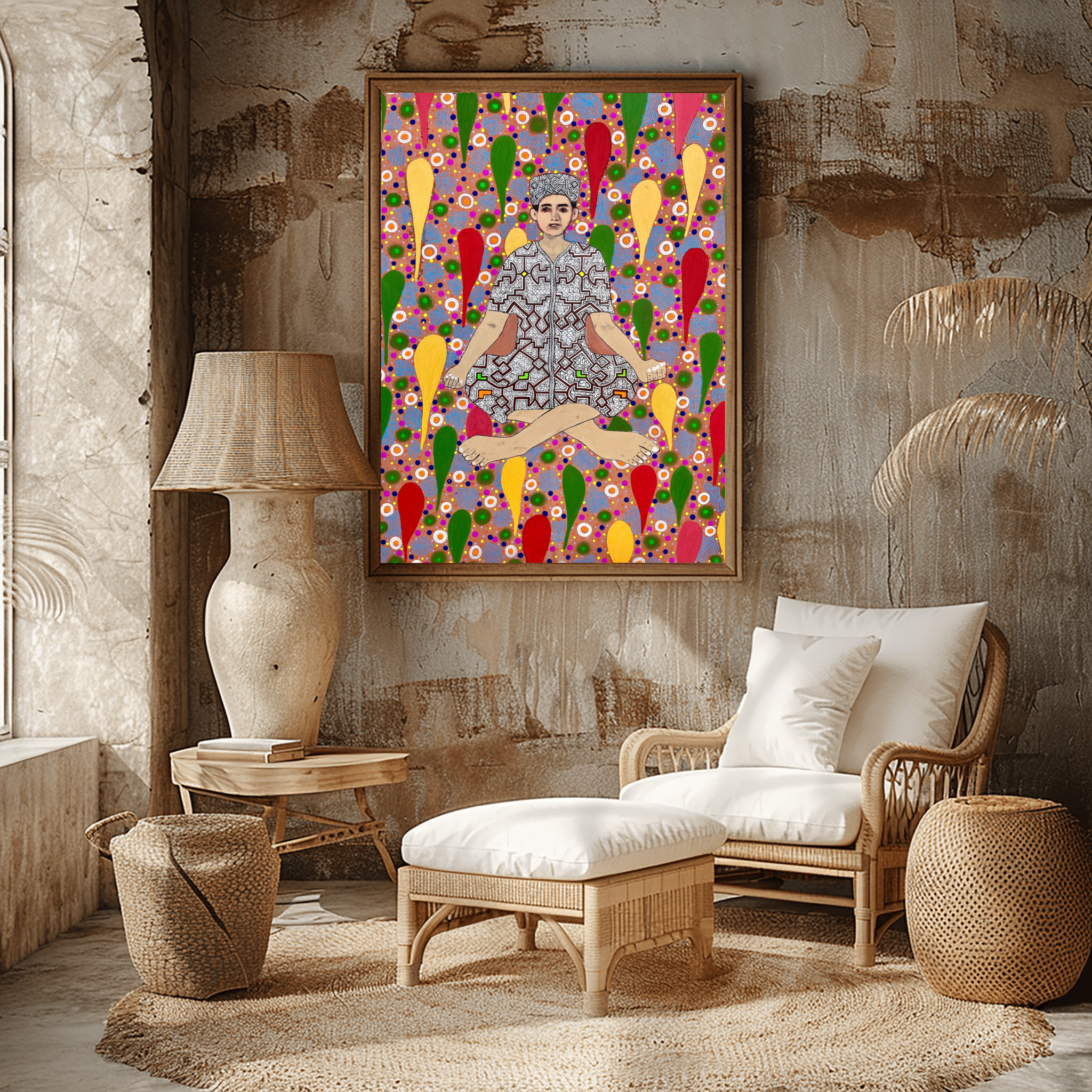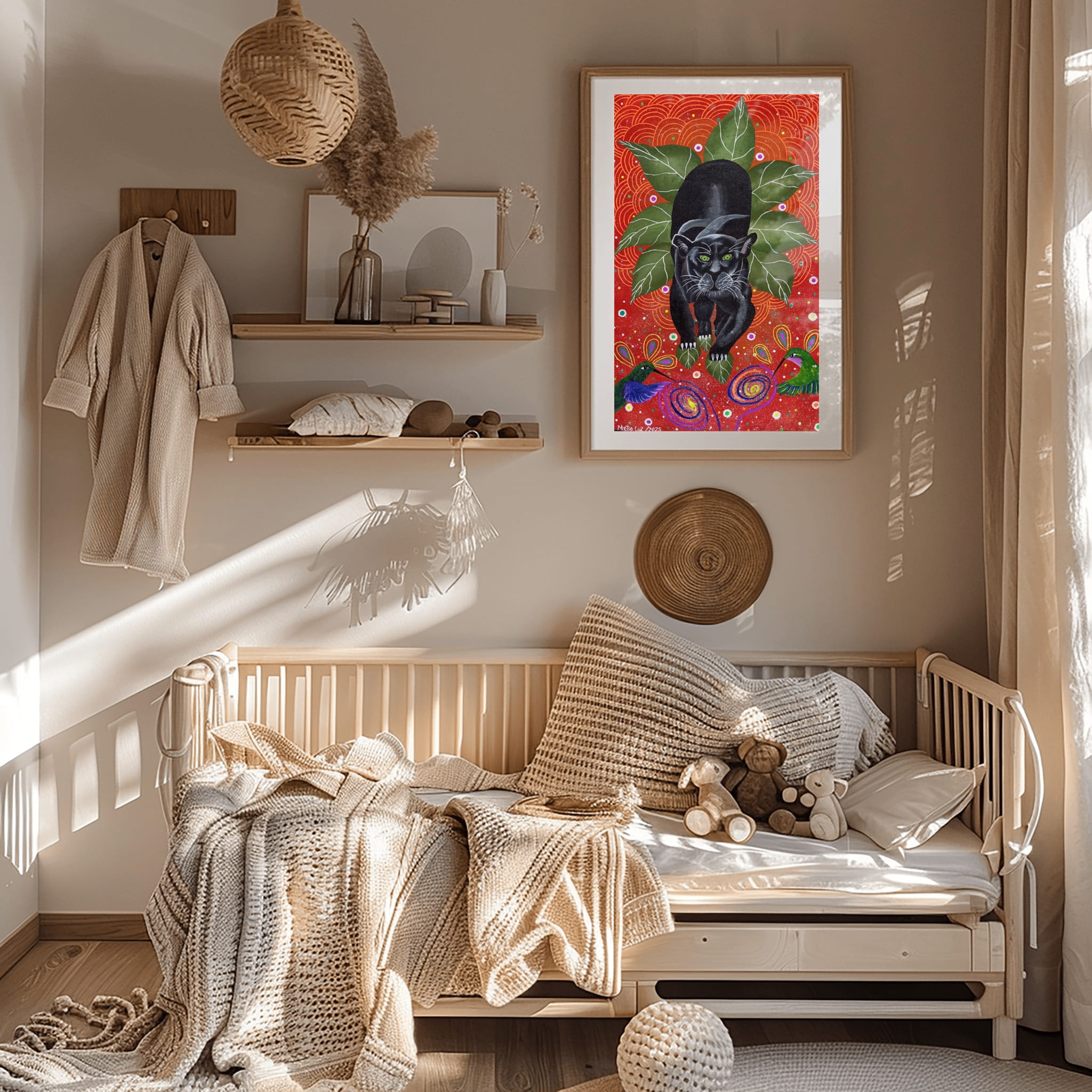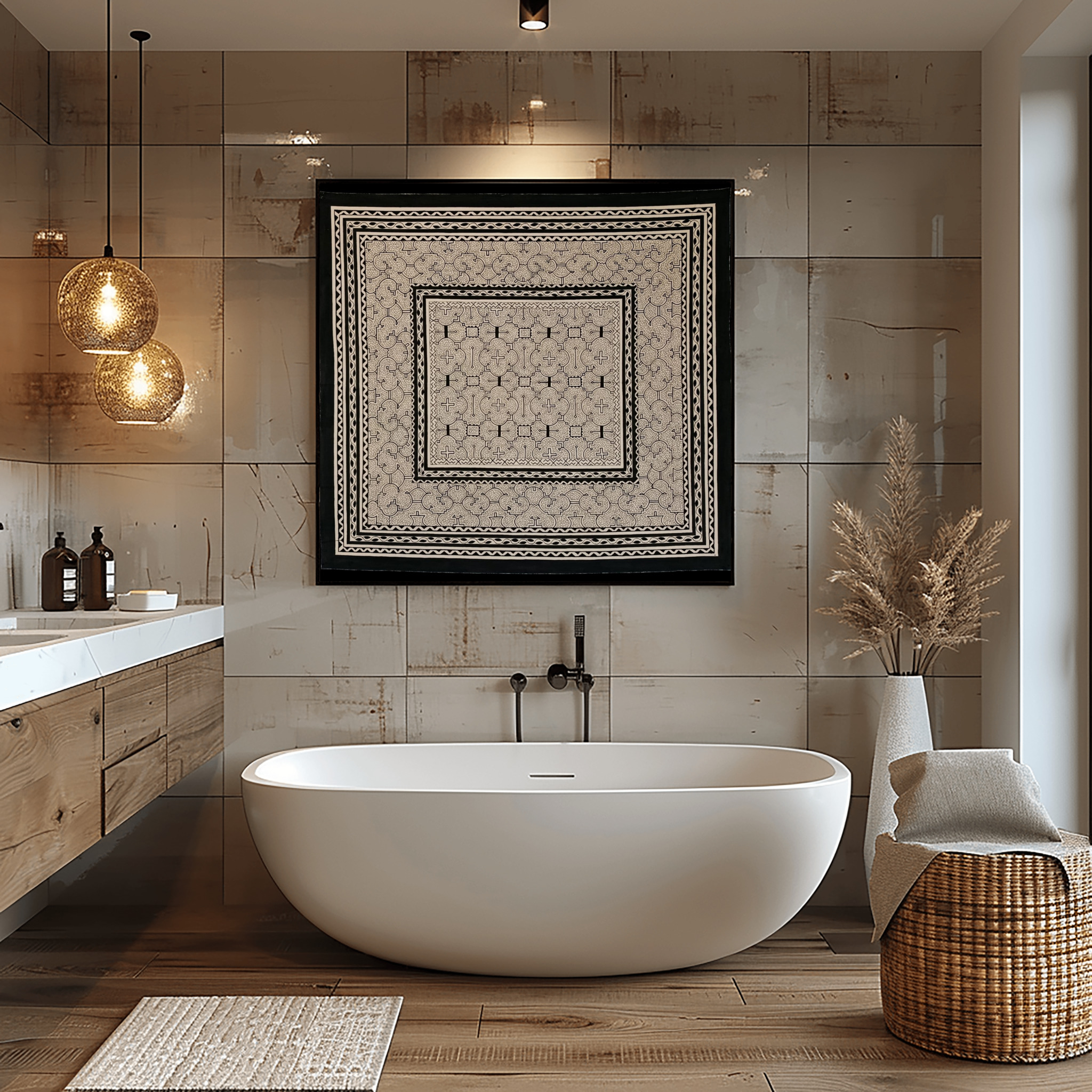
A Visual Language, Not a Decoration
When you stand in front of a Shipibo kene painting for the first time, you may struggle to find an entry point. The surface is covered edge to edge in intricate geometric lattices — crossing lines, nested diamonds, curves that suggest infinity. Your eye searches for a focal point and finds none. That is intentional.
Kene is not decoration. It is a visual language — the externalisation of a healing song called an icaro. In the cosmology of the Shipibo-Konibo people, every illness is a disruption of pattern, and every cure is the restoration of harmony through song. The healer sings, and the universe rearranges itself. Kene makes that rearrangement visible.
The Shipibo-Konibo People
The Shipibo-Konibo are an indigenous Amazonian people living primarily along the Ucayali River in the Peruvian Amazon, with a population of approximately 45,000. They have maintained a continuous ceremonial and artistic tradition for centuries, with kene at its centre.
In their cosmological understanding, the universe is organised as a vast, interlocking geometric pattern — visible to those trained to see it, particularly during ayahuasca ceremony. The healer (onaya) navigates this pattern-world to diagnose and repair disruption. Kene art is one of the primary means by which this invisible world is made tangible.
What Does "Kene" Mean?
In the Shipibo language, kene means "design" or "pattern," but the word carries cosmological weight that "design" cannot contain. A pattern is purely visual; kene encodes the structure of the cosmos itself.
The Shipibo worldview holds that when a person falls ill, their personal kene — the invisible energetic pattern that defines their unique being — has become distorted. Healing means restoring that pattern. The healer's icaros are the sonic form of the cure; kene art is its visual form. In ceremony, practitioners describe "seeing" the icaros as geometric patterns moving through space.
Illness, in this tradition, is essentially aesthetic: a disruption of the beautiful order that underlies all life.
The Art of Seeing Sound
"When I sing an icaro, I can see it. It moves like light, like a river of lines. When I paint kene, I am writing that light down so it does not disappear." — Shipibo kene artist, Ucayali, Peru
This synesthetic relationship between sound and pattern is central to understanding kene art. The geometric forms are not invented — they are observed. The artist, trained through years of ceremony and apprenticeship (often beginning in childhood under a grandmother or mother), develops the ability to perceive the icaros as visual forms and to reproduce them with precision on cloth, ceramic, wood, or canvas.
This is why kene art is fundamentally different from geometric abstraction in the Western tradition. Mondrian, Malevich, and Bridget Riley all invented their grids. Shipibo kene artists transcribe theirs.
Visual Characteristics of Kene Art
What distinguishes authentic kene from decorative geometric art?
- Bilateral symmetry: Most kene compositions have a central axis from which patterns mirror outward. This symmetry reflects the cosmic order the art embodies.
- Fractal complexity: Zoom in and you find smaller patterns nested within larger ones, often repeating the same structural logic at multiple scales.
- Freehand precision: Traditional kene is drawn without rulers, stencils, or underdrawing. Lines meet across the canvas with startling accuracy — an achievement requiring years of practice.
- Earth and natural pigments: Traditional pieces use pigments derived from plants and earth — ochres, deep browns, black from charred seeds. Contemporary artists sometimes use acrylics while maintaining traditional compositional rules.
- Feminine authorship: Kene is traditionally a women's art form. It is transmitted from grandmother to daughter, from mother to daughter, through sustained apprenticeship. When you collect a kene painting, you are collecting the living continuation of a centuries-long feminine lineage.
Peru's Cultural Heritage Recognition
In 2008, Peru's Ministry of Culture declared Shipibo-Konibo kene a part of the Nation's Cultural Heritage. This recognition formalised what practitioners had always known: kene is not craft. It is a living intellectual, spiritual, and artistic tradition of the highest order.
The declaration carries practical weight: it creates a framework for protecting the tradition against imitation and misappropriation, and it establishes the cultural context that gives kene its value — aesthetic, historical, and ceremonial.
SHOP ORIGINAL KENE ART
Original Shipibo kene paintings from $380
All originals include a certificate of authenticity and artist biography. Fair trade certified. Ships worldwide from Costa Rica.
VIEW SHIPIBO KENE COLLECTIONHow Kene Art Is Made
The process begins with intention, not sketching. A kene artist does not plan a composition in advance. She begins at one corner — or at the centre — and allows the pattern to emerge, trusting the visual logic she has internalised over years of practice.
There is no underdrawing. Lines are drawn directly in a single pass, meeting across long distances with the accuracy of a trained hand. If a line goes slightly wrong, the composition accommodates it — kene is not rigid but alive, capable of absorbing small variations while maintaining its structural coherence.
On canvas, the artist typically begins with a background wash — often a warm ochre or cream — then builds the black-and-earth-tone lattice on top. Large pieces can take weeks to complete. During the process, the artist may sing quietly — drawing and singing simultaneously, maintaining the connection between the sonic and visual forms of the kene.
How to Identify Authentic Kene Art
As Shipibo kene gains international recognition, the market inevitably produces imitations. Here is what to look for:
- Artist attribution: Authentic kene is attributed to a named individual artist, not to "Shipibo artisans" generically. The artist should be identifiable as part of the Ucayali community tradition.
- Pattern consistency: Authentic kene has a coherent internal logic — patterns relate to each other, the symmetry holds, and the composition has the quality of a system, not a surface. Imitations tend to have patterns that look similar but don't actually connect or hold together structurally.
- Certificate of provenance: Reputable galleries include a certificate of authenticity identifying the artist, the community, the materials used, and the date of creation.
- Fair trade verification: Ask whether the gallery has a direct relationship with the artist or community, and whether the artist receives transparent compensation.
Collecting Kene Art — Prices and What to Expect
Original Shipibo kene paintings range from approximately $380 for smaller works to $3,700 for large-format pieces. This range reflects size, the complexity of the pattern, and the reputation of the artist within the tradition.
Canvas prints are available from $280 — a good entry point for collectors who want to live with kene before committing to an original. All prints reproduce the full pattern at high resolution.
International shipping from Costa Rica is a flat $150 USD, and all originals arrive with a certificate of authenticity and artist biography. Pieces ship professionally packed within 3–5 business days.
If you are building a collection that mixes traditions, kene pairs particularly well with visionary ayahuasca paintings — the geometric structure of kene and the narrative complexity of visionary work create a dialogue about the same ceremonial world seen from different angles. See our guide: A Collector's Guide to Ayahuasca Art.